
25% of Law Firms Have Been Breached
Law firms need to safeguard their sensitive data from cyber criminals. Unfortunately, only a small percentage of law firms actually do.
5 min read
Mark Bassingthwaighte, Risk Manager
:
Posted on November 3, 2026
ALPS recently conducted a second survey of its insureds for the purpose of learning more about how solo and small firm lawyers feel about the use of generative AI in law. We thought it would be fun to compare the results of our initial 2024 survey with the results of this current survey along with a concluding summary of my takeaways. Also, of note, the number of respondents for this second survey surpassed 2024 by over 300%, so thank you to all who participated!
About the Survey Data: All survey findings and statistics presented in this article are original ALPS data, based on surveys conducted by ALPS among its policyholders regarding their views and experiences with artificial intelligence in the legal industry. Comparisons reflect responses collected through ALPS’s 2024 and 2026 surveys. The findings represent participating respondents and should not be interpreted as representative of the entire legal profession.
Answer: In 2024, 80% of our respondents reported no compared to 46% in 2026.
Answer: In 2024, of the 20% who were currently using AI tools, 72% of them reported they were using the publicly available generative tools ChatGPT, Gemini, and/or Copilot and 55% reported using the specialized generative AI tool Westlaw Edge, Lexis+ AI, or CoCounsel.
While the list of available tools was expanded for the 2026 survey, of the 54% who are currently using AI tools, 78% reported using ChatGPT, Gemini, Copilot and/or Claude and 38% reported using one or more of the specialized generative AI tools West/ Precision/Westlaw AI, Lexis+ AI, or CoCounsel.
Answer: In 2024, the overwhelming majority of answers expressed concerns with the accuracy and reliability of the output (the hallucination problem) or with the privacy and security of information put in (lack of trust in the tool). Notable additional reasons shared included no perceived need for these tools and no idea how to use them.
For all practical purposes, the reasons shared in 2026 matched 2024, with one exception. This time around a small number of respondents found their use of various AI tools to be a waste of time.
Answer: In 2024, 49% reported no current plans to adopt, 28% were interested in using it but waiting for legal acceptance, 16% were researching its usage possibilities, and 7% planned to adopt it within the next year.
Interest in future AI adoption has dropped slightly in 2026 with 55% now reporting no current plans to adopt, 25% are researching its usage possibilities, 14% expressed an interest in using it but are waiting for legal acceptance, and only 5% plan on adopting it within the next year.
Answer: Of those who were currently using generative AI in 2024, only one reported just running with the output. Everyone else reported varying degrees of review with the majority taking the time to thoroughly review the output, to include checking all citations (a trust but verify process).
While the responses in 2026 generally mirrored what was reported in 2024, a greater number of respondents made it clear that their AI output review process is now considered mandatory. No one reported just running with the output, even if the output was for a rough first draft.
Answer: In 2024, a majority of the answers to this question focused on ethical and malpractice missteps (inaccurate outputs, data privacy, and undue reliance), with a few other outliers that ran the gamut. Representative outlier quotes included “The list is endless;” “It’ll take over the world like that one movie;” “Lack of accountability and the dumbing down of the industry.”
An overwhelming majority of the responses in 2026 mirrored those shared in 2024, to include a few more agreeing with the “dumbing down of lawyers” outlier comment from 2024. Inaccurate outputs, data privacy, and undue reliance remain front and center. That said, quite a few respondents broadened their concerns by including AI usage by clients and pro se individuals, particularly with the undue reliance concern and the associated costs this is bringing about. A few notable outlier responses this time around were “My entire field being eliminated by it and having to dig ditches for a living,” “I’m worried about a further disparity between the haves and the have nots,” and “None in my practice because in another year or so I will be fully retired!”
Answer: In 2024, 77% of respondents thought no. Two years later this percentage has dropped to 57%.
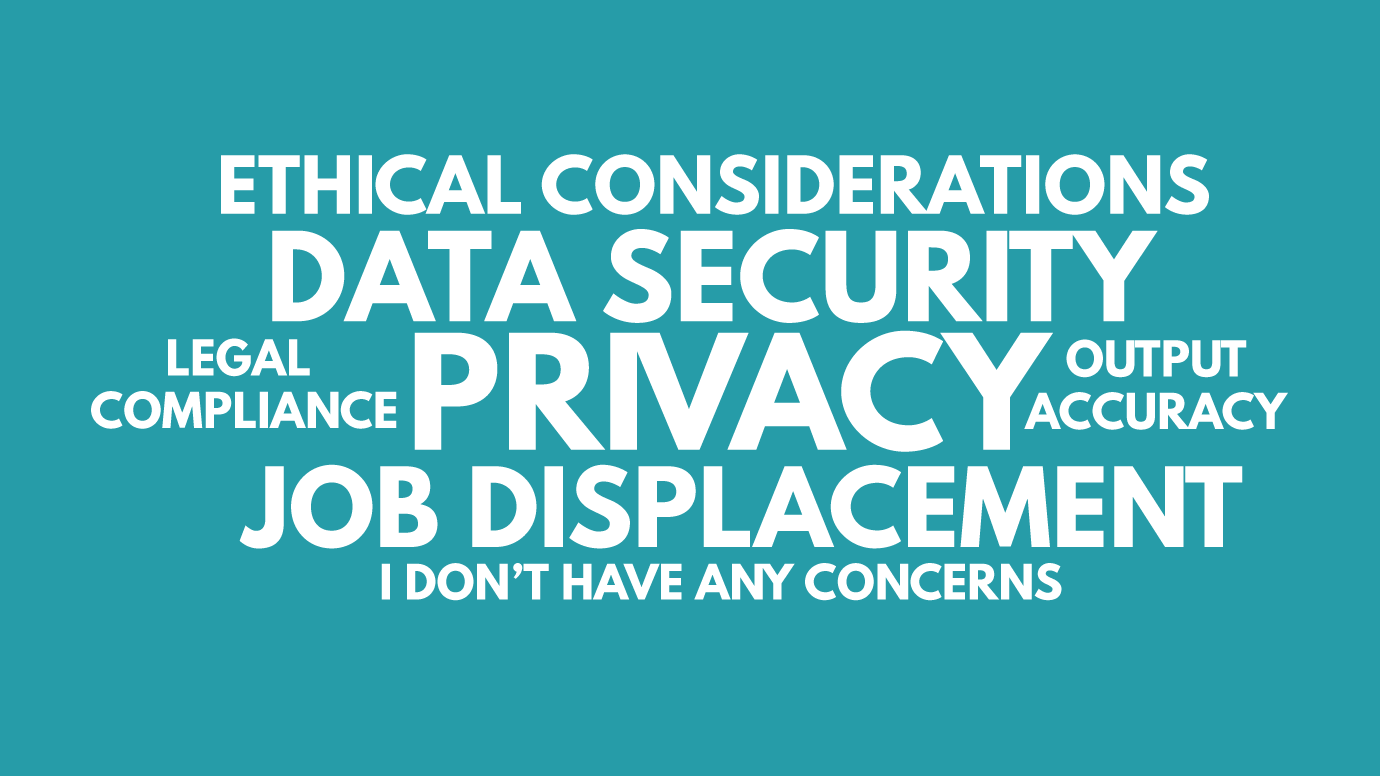
Answer: (Note that respondents could select more than one answer from a list of concerns.) In decreasing order for 2026, the concerns respondents found most troubling were:
| 2024 | 2026 | |
| Output Accuracy | 81% | 86% |
| Ethical Considerations | 85% | 78% |
| Data Security/Privacy | 62% | 74% |
| Legal Compliance | 67% | 72% |
| Job Displacement | 27% | 24% |
| I Don’t’ Have Any Concerns | 1% | 2% |
| Not Applicable | 2% | 0% |
Answer: In 2024, just 32% of respondents said yes. In 2026 that number rose to 42%.
Answer: Of those who felt AI had the potential to replace paralegals in 2024, no one felt this would happen within the next year, 59% felt this will happen in the next 2 to 5 years, 33% thought it will take 6 to 10 years, and 2% thought it will be 10+ years.
Things have changed slightly over the past two years. Now 10% believe this will happen within 1 year, 56% believe it will take place in the next 2 to 5 years, another 25% believe it will be within the next 6 to 10 years, and 8% believe it will be 10+ years.
Answer: Here our respondents were a bit more optimistic with only 21% saying yes in 2024 and 22% saying yes in 2026.
Answer: For those few who thought their days were numbered in 2024, 1% thought this would happen within a year, 50% thought it will take 2 to 5 years, 33% thought it will take 6 to 10 years, and 11% believed it will be 10+ years.
For those few who believe in 2026 that their days may be numbered, 9% believe it will happen within one year, 31% think it will take 2 to 5 years, 30% believe it will take 6 to 10 years, and the remaining 30% believe it will be 10+ years.
Answer: 86% of the respondents said yes in 2024. Since then, there’s been a slight decrease with the number now sitting at 81%.
| 2024 | 2026 | |
| State Bar Associations | 73% | 74% |
| The ABA | 54% | 46% |
| Practice Area-specific Associations (i.e., Trial Lawyers Association) | 21% | 20% |
| It Should Be Up To The Firm To Monitor | 19% | 36% |
| Local Bar Associations | 12% | 14% |
| None | 11% | 6% |
As I reflect on the results of this second survey, the data indicates that our profession is rapidly increasing its use of AI while maintaining deep and persistent concerns about accuracy, privacy, and ethical risk. Despite this surge in adoption, the reasons for avoiding AI remain largely unchanged. Attorneys continue to worry about hallucinations and data security, with a new 2026 theme emerging as some lawyers now view AI as a waste of time. Future AI adoption interest appears to be softening, with more respondents reporting no plans to adopt AI and fewer planning to adopt within the next year, suggesting that those inclined to experiment have already done so while remaining holdouts are increasingly entrenched.
At the same time, internal review processes of AI output have matured significantly. Many now describe their review process as mandatory even for rough drafts. Perceived threats have also broadened. While concerns about inaccurate outputs, privacy, and undue reliance remain central, lawyers in 2026 increasingly worry about the impact of client and pro se misuse of AI, the costs associated with correcting AI‑generated errors, and job displacement. A belief that AI could replace paralegals has grown from 32% to 42%, with timelines accelerating, though a belief that AI could replace lawyers remains low and essentially unchanged at 21% to 22%. Among those who do fear lawyer displacement, expectations have shifted toward shorter timelines.
Finally, support for AI regulation remains strong but has dipped slightly from 86% to 81%. State bar associations continue to be the preferred regulators, though support for firm‑level self‑monitoring has risen sharply. Overall, the data suggests a profession that is adopting AI quickly but not necessarily confidently. In short, our profession is one that is becoming more disciplined in its review practices, more aware of systemic risks, and more divided about the pace and direction of future adoption.
Law firms need to safeguard their sensitive data from cyber criminals. Unfortunately, only a small percentage of law firms actually do.

Law firms are at a greater risk of a cybersecurity breach now more than ever, due to COVID-19 as well as the rise of cloud-based document storage.

As you consider bringing smart technology tools into your law office, consider the ethical implications of doing and the potential cybersecurity...